
Hotel Forecasting Has Changed, Here’s What That Means for Leaders
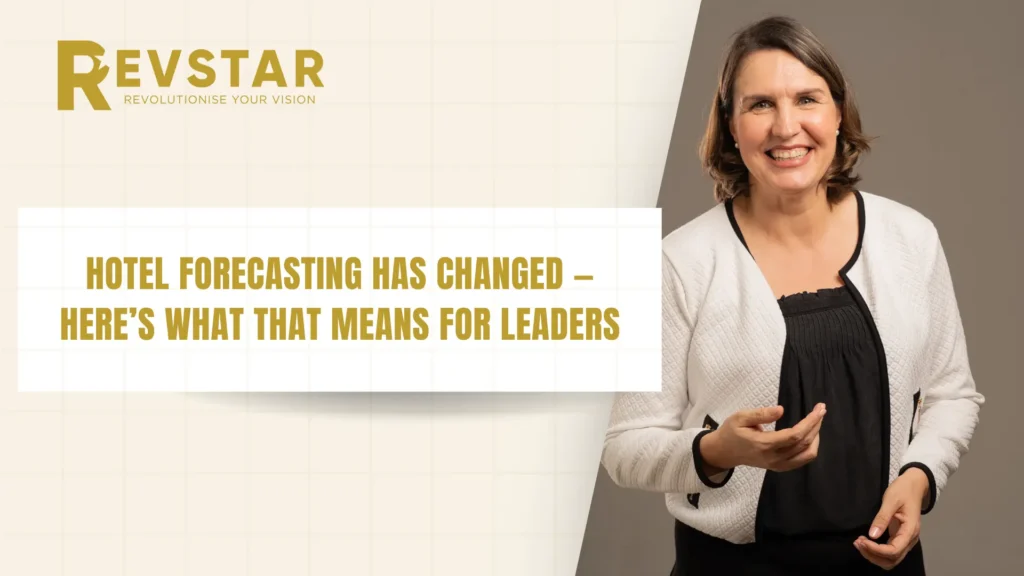
Forecasting used to be a routine exercise, take last year’s numbers, adjust for a few events, and call it a plan.That approach doesn’t work anymore. Market behavior has changed too quickly. Demand shifts faster, booking windows have shortened, and external influences, from flight capacity to weather and even visa regulations, reshape demand almost overnight. The reality for hotels today is simple: you can’t rely on the past to predict the future. From Historical Data to Real-Time Context When we forecast now, we start by looking at the environment, not just the numbers.What flights are coming into the destination? What’s their load factor? Are airlines reducing or adding capacity? How’s the weather shaping up during key periods? These aren’t just operational details, they’re early signals of demand.If, for example, flight capacity from Singapore drops 15%, you’ll feel it in your pickup before the month ends. The faster we read those signals, the faster we can adjust our strategy. Once you understand those dynamics, then you look at your segments:Which markets are expected to perform? Which ones carry the highest risk of softening?From there, you start shaping your forecast — not as a single prediction, but as a set of possible outcomes. Three Scenarios: Base, Risk, and Best Case A modern forecast isn’t one number on a sheet. It’s a structure for decision-making. Once those scenarios are mapped, you link each one to market actions: pricing moves, tactical offers, and digital campaigns that are ready to activate. That’s the real value, not the forecast itself, but the preparation it enables. Agility Is the Competitive Edge No forecast will ever be perfect. That’s not the goal anymore. The goal is to be agile, to have every scenario planned and every response ready so the hotel can pivot fast.When one feeder market weakens, you already have the campaigns, packages, or domestic strategies “in the drawer” to fill the gap. That speed of reaction is what protects occupancy and rate. Hotels that build this discipline outperform those that wait for the next monthly review to adjust course. Forecasting as a Leadership Tool Forecasting today is no longer just a revenue management task, it’s a leadership process.It connects commercial teams, marketing, and operations around a single, forward-looking view. It’s how you ensure the business isn’t just reacting to market changes, but anticipating them.It’s how you stay proactive when the environment moves faster than your systems. And it’s how you lead your team with confidence, because you know, even if one scenario fails, you already have the next one ready to execute. In Summary Forecasting has moved from accuracy to agility.It’s about understanding your environment, preparing for multiple outcomes, and ensuring every lever, rate, segment, and marketing, is ready to deploy. You might not always get it perfect. But if you can react faster than the market, you’ll still finish the season strong, with both occupancy and rate in control.
Dynamic Pricing in Hotels: How AI is Changing the Game
Introduction In the competitive world of hospitality, pricing rooms correctly can mean the difference between maximizing revenue and leaving money on the table. Traditional static pricing models are no longer enough today’s hotels need dynamic pricing powered by Artificial Intelligence (AI) to stay ahead. But what exactly is dynamic pricing, and how is AI transforming the way hotels set their rates? Let’s explore. What is Dynamic Pricing in Hotels? Dynamic pricing is a strategy where room rates adjust in real-time based on: Unlike fixed pricing, dynamic pricing ensures hotels capture the highest possible revenue at any given moment. The Role of AI in Dynamic Pricing AI has revolutionized dynamic pricing by enabling: 1. Real-Time Data Analysis 2. Predictive Demand Forecasting 3. Competitor Rate Benchmarking 4. Personalized Pricing Benefits of AI-Driven Dynamic Pricing ✅ Higher Revenue & Profit Margins – No more underpricing during high demand or overpricing during low seasons.✅ Better Occupancy Rates – Smart pricing fills more rooms without drastic discounts.✅ Reduced Manual Work – AI automates pricing decisions, freeing up revenue managers for strategy.✅ Competitive Edge – Hotels using AI outmaneuver those relying on guesswork. Challenges & How to Overcome Them ❌ Data Overload – Not all data is useful. Solution: Use an AI system that filters noise and focuses on key metrics.❌ Resistance to Change – Some teams fear automation. Solution: Educate staff on AI’s role as an assistant, not a replacement.❌ Implementation Costs – AI tools require investment. Solution: Start with scalable solutions (like Revstar) that offer quick ROI. The Future of Hotel Pricing As AI continues to evolve, we’ll see: Hotels that embrace AI-driven dynamic pricing now will lead the industry in revenue optimization. Conclusion Dynamic pricing is no longer optional—it’s a necessity for hotels that want to thrive. With AI-powered tools like Revstar, revenue managers can make smarter, faster, and more profitable pricing decisions without the guesswork. Is your hotel using dynamic pricing effectively? If not, it might be time to explore AI-driven solutions.
Strategic Priorities for Hotel Commercial Leaders Amid the New Tourism Boom
Tourism and Hospitality Trends 2024: A New Era of Growth and Personalization Tourism and hospitality are experiencing a significant rebound and transformation in 2024. The return of travel demand is being shaped by four major forces: proximity-driven travel (domestic and intraregional), a more personalized and diverse traveler base, a surge in luxury and experiential travel (especially in Asia), and destination readiness to handle increasing volumes and expectations. New source markets (India, Southeast Asia, Eastern Europe) and shifting traveler behaviors (younger, tech-savvy, experience-focused) are redefining the competitive landscape. The luxury market, in particular, is growing faster than any other segment, fueled not just by the ultra-rich but also by aspirational travelers. What This Means for Hotel Commercial Leaders 1. Prioritize Domestic and Regional Strategies Tool examples: 2. Segment and Personalize Offerings Tool examples: 3. Rethink the Luxury Traveler Tool examples: 4. Capture Emerging Markets Early Tool examples: 5. Leverage Social Media and User-Generated Content Tool examples: 6. Optimize for Experience-Driven Spending Tool examples: 7. Build Destination Partnerships Tool examples: 8. Plan for Capacity and Talent Needs Tool examples: For more information, read this PDF.
Summary: McKinsey – What AI Means for Travel Now and in the Future
The McKinsey report highlights how artificial intelligence (AI), especially generative AI, is beginning to reshape the travel industry. From personalized customer experiences to operational efficiency, AI has the potential to dramatically improve how travel businesses interact with customers and manage backend logistics. The key promise lies in hyper-personalization, predictive insights, and seamless delivery while still relying on the irreplaceable human touch. Although AI is not a silver bullet, it is becoming an essential tool for companies aiming to meet rising traveler expectations and improve efficiency in an industry rebounding from the pandemic. 3 Key Takeaways for Travel & Hospitality Leaders: 1. Personalization at Scale AI enables a “segment of one” approach, tailoring travel offers based on individual behavior and preferences. 2. Operational Intelligence & Consistency AI can optimize complex travel logistics (e.g., aircraft turnaround, room readiness) and spot issues in real time. 3. Human-Plus-AI Workforce Enablement Rather than replacing staff, AI enhances the capabilities of frontline employees and accelerates training through virtual tools. 4. Smarter Data Utilization & Micro-Testing AI learns like humans: through test-and-learn cycles. Companies should focus on measurable, small-scale experiments rather than trying to apply broad, vague personalization. 5. Experience Delivery Matters as Much as the Prediction Getting the delivery right is critical. Even the best AI insights are ineffective if they aren’t communicated or executed properly via the right channels (app, agent, notification). For more information, read this PDF.
How AI is Revolutionizing Sustainable Travel
Summary Artificial intelligence is becoming a critical driver of sustainability in the travel industry, helping companies reduce environmental impact while improving efficiency. From optimizing aircraft routes to cutting hotel food waste, AI tools are supporting smarter decisions across the sector. Initiatives such as predictive aircraft maintenance, AI-powered food waste tracking, and intelligent hotel energy systems are already delivering measurable environmental gains. AI is also aiding consumers in choosing truly eco-friendly travel options by reducing the risk of greenwashing. 5 Key Takeaways on How AI is Advancing Sustainability in Travel 1. Reducing Aviation Emissions with Smarter Flight Paths AI provides pilots with real-time weather data and predictive models to adjust routes mid-air, reducing fuel burn and CO₂ output. 2. Cutting Contrails to Combat Global Warming AI helps aircraft avoid humid areas that form contrails—responsible for approximately 35% of aviation’s warming effect. 3. AI-Driven Predictive Maintenance for Efficiency Airlines use AI to detect maintenance needs before issues arise, minimizing last-minute repairs, delays, and environmentally costly logistics. 4. Minimizing Hotel Food Waste with AI Insights Smart kitchen bins use AI to analyze food waste by source and type, helping chefs adjust portioning and prep methods. 5. Smarter Energy Use in Hotels AI systems coordinate between hotel appliances (like A/C) using weather forecasts and usage patterns to maximize energy efficiency. For more information, read this article: How travel is getting smart – and more sustainable – with AI (Reuters)
Case Study: OTA and Opera PMS Integration for a Hotel in Zanzibar
Background: A luxury resort in Zanzibar, partnered with Revstar Consultancy to address challenges related to room type alignment and OTA (Online Travel Agent) integration during the migration to Opera Cloud PMS (Property Management System). Misalignment across systems caused inconsistencies, affecting booking efficiency and guest experience. Revstar’s consultants, led by Katja Ruethemann and operationalized by Rawiporn Oonyankowit (“Give”), were engaged to streamline and realign room types, rate plans, and distribution channels. Challenges Identified: Diagram showing the integration process between Opera PMS, GuestCentric, OTAs, and Siteminder Actions Taken: 1. Room Types & Naming Alignment: 2. Rate Plans Setup: 3. Siteminder and Hotelbeds Mapping: Next Steps: Results Expected: Key Stakeholders:
Duis Convallis Eleifend Turpis Sollicitudin Vehicula. Aliquam Erat Volutpat. Morbi Vel Lacinia Nunc, Non Porttitor Tortor.

Sed tincidunt posuere nunc eu aliquam. Pellentesque habitant morbi tristique senectus et netus et malesuada fames ac turpis egestas. Morbi sit amet lectus mollis, egestas felis semper, eleifend orci. Maecenas blandit aliquet mi id egestas. On The Day Of The Shoot : Vestibulum in ipsum velit. Aliquam libero sem asfds asf, rutrum eu scelerisque ut, vehicula a erat. Phasellus ac sem sed erat pos se quam dignissim. Mauris feugiat, nisi nec dapibuasas a gas dictum, ligula nulla gravida ante, non aliquet odio elit ac orci. Curabi tinc Nunc eu rhoncus justo, nec mattis risus auris consequat viverra sapien id lobortis. Vivamus auctor turpis vel dignissim licitudin. Quisque eget risus maximus erat porttitor tincidunt vitae ac nulla. Ut ut augue id ex vehicula ferme sit amet felis. On The Day Of The Shoot : ✦ Vestibulum in ipsum velit. Aliquam libero sem asfds asf,✦ ut, vehicula a erat. Phasellus ac sem sed erat pos se✦ feugiat, nisi nec dapibuasas a gas dictum, ligula nulla✦ odio elit ac orci. Curabi tinc✦ Nunc eu rhoncus justo,✦ consequat viverra sapien id lobortis. Vivamus auctor
Duis Convallis Eleifend Turpis Sollicitudin Vehicula. Aliquam Erat Volutpat. Morbi Vel Lacinia Nunc, Non Porttitor Tortor.

Sed tincidunt posuere nunc eu aliquam. Pellentesque habitant morbi tristique senectus et netus et malesuada fames ac turpis egestas. Morbi sit amet lectus mollis, egestas felis semper, eleifend orci. Maecenas blandit aliquet mi id egestas. On The Day Of The Shoot : Vestibulum in ipsum velit. Aliquam libero sem asfds asf, rutrum eu scelerisque ut, vehicula a erat. Phasellus ac sem sed erat pos se quam dignissim. Mauris feugiat, nisi nec dapibuasas a gas dictum, ligula nulla gravida ante, non aliquet odio elit ac orci. Curabi tinc Nunc eu rhoncus justo, nec mattis risus auris consequat viverra sapien id lobortis. Vivamus auctor turpis vel dignissim licitudin. Quisque eget risus maximus erat porttitor tincidunt vitae ac nulla. Ut ut augue id ex vehicula ferme sit amet felis. On The Day Of The Shoot : ✦ Vestibulum in ipsum velit. Aliquam libero sem asfds asf,✦ ut, vehicula a erat. Phasellus ac sem sed erat pos se✦ feugiat, nisi nec dapibuasas a gas dictum, ligula nulla✦ odio elit ac orci. Curabi tinc✦ Nunc eu rhoncus justo,✦ consequat viverra sapien id lobortis. Vivamus auctor